
Free tool · no signup · runs in your browser
Transaction value and duty calculator
How is a customs broker exam transaction value and duty problem worked?
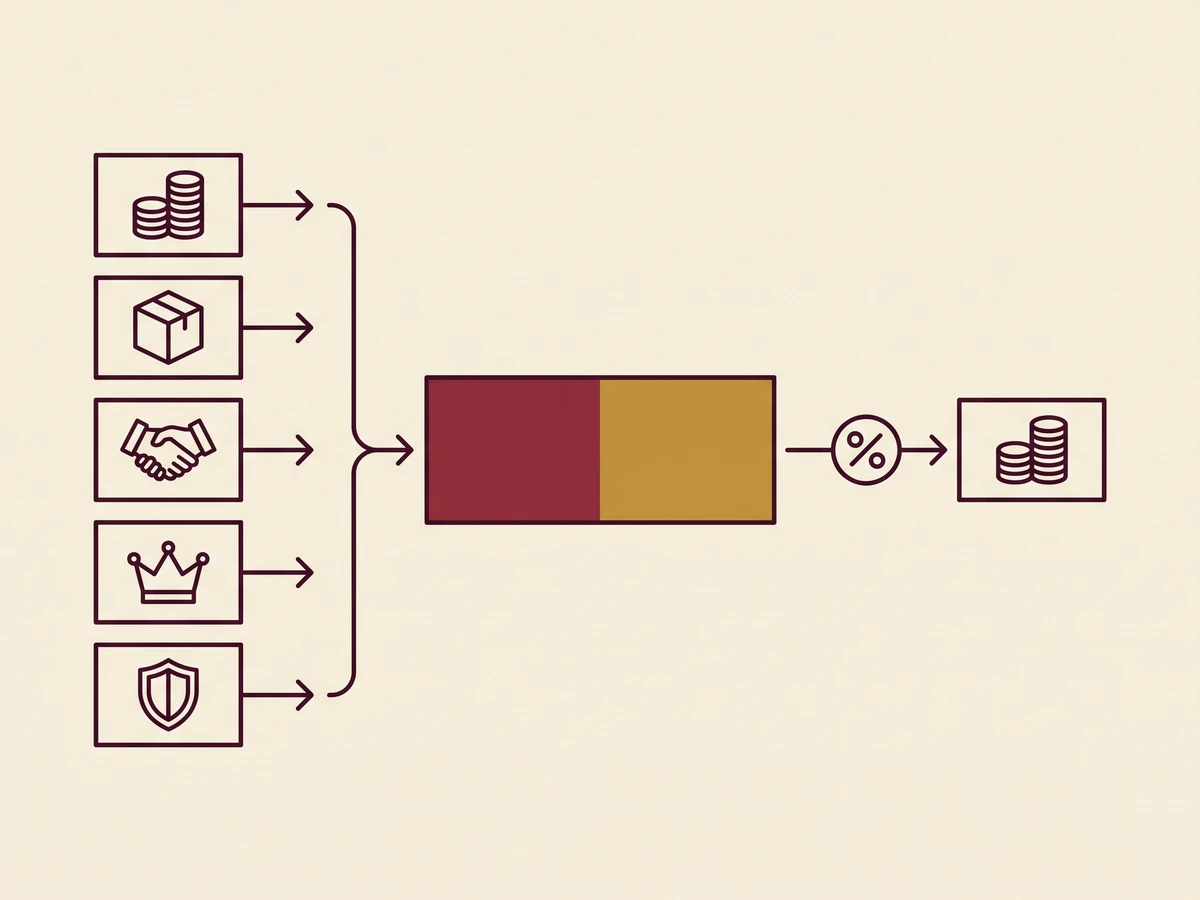
Transaction value is the price actually paid or payable for imported merchandise, plus five statutory additions: packing costs, selling commission, the value of an assist, royalties required as a condition of sale, and proceeds of resale to the seller. International freight, insurance, and post-importation costs are excluded if separately identified. Duty is that value multiplied by the applicable ad valorem rate.
Calculator
Study and planning tool only, not a customs declaration or a substitute for professional advice. Confirm the current duty rate for your specific HTSUS classification at hts.usitc.gov before relying on any figure operationally, and confirm valuation treatment for a real entry with a licensed customs broker or CBP.
How transaction value is built
Transaction value is method 1 of the six-step valuation hierarchy, used for the great majority of entries. It starts with the price actually paid or payable, defined as the total payment the buyer makes to, or for the benefit of, the seller, then adds five statutory items only to the extent not already included in the price, and only when based on sufficient information (19 CFR 152.103(b)(1), (i)).
| Addition | What it covers |
|---|---|
| Packing costs incurred by the buyer | Costs of packing, whether for labor or materials, that the buyer incurs with respect to the imported merchandise. |
| Selling commission | A commission paid to the seller's agent, who is related to or works for or on behalf of the seller. A buying commission paid to the buyer's own agent is not added. |
| Value of an assist | The apportioned value of materials, tools, dies, molds, or engineering and design work the buyer supplied free or at reduced cost for producing the merchandise. |
| Royalty or license fee | Any royalty or license fee the buyer must pay, directly or indirectly, as a condition of the sale. |
| Proceeds of resale to the seller | Proceeds of any subsequent resale, disposal, or use of the merchandise that accrue to the seller. |
| Exclusion | What it covers |
|---|---|
| International freight and insurance (if separately identified) | Cost of transportation, insurance, and related services incident to moving the goods from the country of export to the place of importation. Customs value is an FOB, not a CIF, value. |
| Post-importation construction, erection, assembly, or technical assistance (if separately identified) | Reasonable costs for construction, erection, assembly, maintenance, or technical assistance performed on the merchandise after it is imported, plus the cost of transporting it after importation. |
Source: 19 CFR 152.103(b)(1), (i), verified 2026-07-29. See the full valuation and transaction value guide for the related-party tests, the assist categories, and a worked example with commentary.
The valuation hierarchy
| Order | Method | In short |
|---|---|---|
| 1 | Transaction value | the price actually paid or payable for the merchandise when sold for export to the United States, plus the statutory additions |
| 2 | Transaction value of identical merchandise | the transaction value of identical merchandise exported to the United States at or about the same time |
| 3 | Transaction value of similar merchandise | the transaction value of similar merchandise when identical merchandise is unavailable |
| 4 | Deductive value | the resale price in the United States, reduced by commissions, transport, duties, and other deductible costs |
| 5 | Computed value | the sum of materials and processing cost, profit and general expense, and packing; an importer may request this before deductive value |
| 6 | Fallback (derived) value | a value derived from the earlier methods applied with reasonable flexibility when none can otherwise be determined |
You use the first method that can be applied and move down only when the method above it cannot be determined. Full detail at the corpus map and the key deadlines reference for the liquidation clock this value feeds into.
Duty calculator FAQ
Is this duty calculator free?
Yes. It runs entirely in your browser with no signup, no email, and no paywall. Your figures stay on your device; when you calculate we receive only anonymous aggregate statistics, such as a banded value range and rate band, with no identifier. See our privacy policy for details.
Why doesn't the calculator look up the duty rate for me?
Duty rates are set line by line in the Harmonized Tariff Schedule, which runs to thousands of headings and changes with trade actions, so a reliable rate lookup needs the current HTSUS itself, not a hand-maintained copy. This tool checks the valuation arithmetic, which is fixed law under 19 CFR 152.103; you supply the rate from your own HTSUS lookup, exactly as you would on the exam.
Is a buying commission added to transaction value?
No. A selling commission, paid to the seller's agent, is one of the five statutory additions. A buying commission, paid by the buyer to its own agent, is not dutiable and is not added. This distinction is a frequent exam trap, which is why the calculator only offers a selling-commission input.
What if freight and insurance are not separately identified on the invoice?
Then they are not excludable. International freight and insurance can only be subtracted from a delivered price if the amount is separately identified on the commercial documents. If those costs are rolled into a single delivered price with no breakout, the full price stays in transaction value.